AI for executive assistants: the career shift
A meeting brief that used to take four hours now takes 75 minutes. The time saved is not the story. The story is what an executive assistant does with the brain space AI gives back.

Jason Kamara
September 30, 2025 · 6 min read
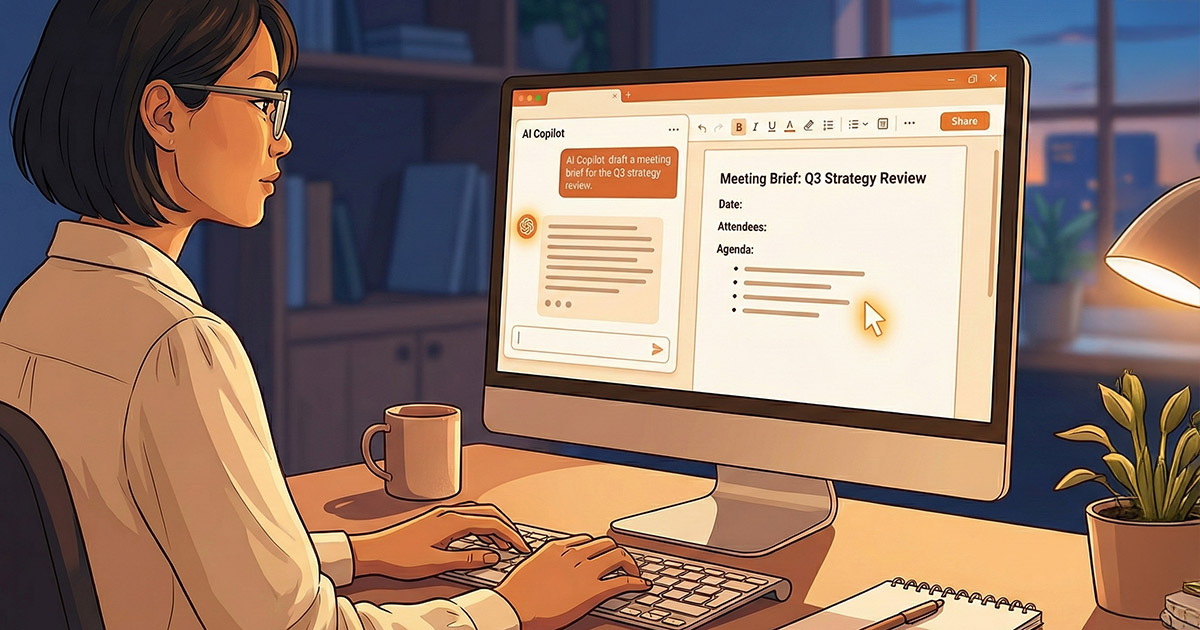
It is 6:45pm on a Tuesday evening. Sarah, an executive assistant at a mid-sized consulting firm, stares at her monitor with a familiar knot in her stomach. Her managing partner’s 9am client pitch needs a meeting brief. Not the two-paragraph summary kind. The comprehensive intelligence document that determines whether tomorrow’s $300,000 pitch succeeds or falls flat.
She rubs her eyes. In the old days, this meant staying until 10pm.
This is strategic work, the kind that happens behind closed doors. The brief needs to synthesize everything: past project deliverables, email history with the client, competitive intelligence, pending issues, strategic recommendations. It is the intelligence that makes her partner look brilliant in the room. But eighteen months ago, this preparation consumed three to four hours of hunting through digital haystacks for needles of information.
The old reality: death by a thousand clicks
The process was soul-crushing. Sarah would:
- Search SharePoint folders for past client deliverables, opening a dozen files to find the right one.
- Scroll through 50+ email threads in Outlook trying to reconstruct the relationship history.
- Manually extract data from multiple Excel spreadsheets to build competitive intelligence.
- Reformat presentations from last quarter to match current brand standards.
- Copy and paste everything into a Word document, hoping nothing critical slipped through the cracks.
The worst part was not the time. It was spending hours on digital archaeology when she could have been thinking strategically. Every minute hunting for files was a minute not spent analyzing what those files meant for tomorrow’s conversation.
The invisible cost to the firm? Partners walked into high-stakes meetings less prepared than they could be, simply because there were not enough hours for proper intelligence preparation.
What changed everything
The transformation did not happen overnight. Sarah’s firm introduced Microsoft 365 Copilot six months ago. She was skeptical. Another tech tool promising to “revolutionize” her work.
Then she tried it for a client brief.
Finding what matters (in minutes, not hours)
She started with Copilot Search, typing conversationally: “Find all project deliverables for Acme Corp from the past 18 months.”
The results understood context. Not every email mentioning the client’s name, but actual final reports, proposals, and presentations. The AI grasped semantic meaning. It knew what “deliverables” meant in consulting work.
Reading between the lines
For email intelligence, Copilot in Outlook did something remarkable. It did not just summarize threads. It extracted insights she would have missed at 9pm after eight hours of work. The AI flagged this: “Client mentioned budget constraints in March but shifted tone in June emails. Possible opening for premium service tier.”
Sarah had read those emails. But exhausted from digging through files, she had missed the pattern.
Making sense of numbers
Copilot in Excel analyzed competitive data across multiple spreadsheets, generated clean visualizations, and created what-if scenarios for pricing discussions. What used to take an hour of manual work now took eight minutes.
The first draft that needed her touch
Agent Mode in Word drafted the comprehensive brief using everything Sarah had gathered. It structured the document properly: client history, pending issues, competitive context, strategic recommendations. It even applied the firm’s formatting standards.
But Sarah did not just accept it. She spent the next 30 minutes fact-checking every data point against source documents, removing generic recommendations that missed industry context, and adding relationship intelligence that does not exist in any file. The AI confidently stated the client’s budget increased 15%. Sarah checked the financials. It was 9%. Close enough for conversation, disastrous for a pitch document.
She added notes about political dynamics between stakeholders. She flagged what not to mention based on previous interactions. She refined the tone to match this specific client relationship.
The reality: AI excels at rough drafts. Human expertise makes them accurate and strategic.
The new reality: strategic, not scrambling
Sarah now finishes the brief by 8:15pm. Total time: 75 minutes instead of 3 to 4 hours.
But the time savings are not the real story. It is what she can do with those 75 minutes.
She is not scrambling anymore. She is not exhausted from hunting through files. Her brain has capacity for the strategic thinking that actually matters: anticipating questions, identifying opportunities, recognizing patterns the AI missed.
The meeting brief is not just comprehensive. It is genuinely strategic. Her partner will walk into that room with accurate intelligence nobody had to explicitly request. He will look prepared because he is prepared, and that preparation came from Sarah’s invisible strategic work.
What this evolution means for your career
This is not about doing less work. It is about doing the work that firms actually value in 2025.
The skills that matter now
- Knowing which questions to ask AI (and which answers to verify).
- Fact-checking expertise that catches subtle inaccuracies.
- Quality control instincts that spot generic content before it matters.
- Adding context that lives in conversations, not documents.
- Understanding business dynamics no algorithm can extract from SharePoint.
The executive assistant who masters AI-powered tools while maintaining strict quality standards becomes genuinely indispensable. Not because they are faster. Because they are more strategically valuable.
Firms recognize this. Strategic intelligence preparation that is accurate protects their partners’ billable time. Bad preparation wastes everyone’s money. Good preparation wins $300,000 pitches.
The trajectory shift
Your role does not shrink. It evolves into something the firm values more. The tedious parts get automated. The strategic parts get more time and attention.
That is not a threat. That is an opportunity for people willing to develop the quality control and strategic thinking skills that AI cannot replicate. Sarah’s firm still has the same team. But what they are asking that team to deliver has fundamentally changed. The work shifted from administrative execution to strategic intelligence. The professionals who have made that shift successfully find themselves in conversations they were not invited to a year ago.
The invisible advantage
Most people will never see Sarah’s meeting brief. But tomorrow morning, her managing partner will win that $300,000 pitch. He will walk in with accurate intelligence no competitor had time to compile. The client will notice he anticipated their concerns. He will have answers to questions they had not planned to ask.
That competitive advantage came from Sarah’s invisible strategic work. Not from AI alone. Not from manual work alone. From the thoughtful combination of AI-assisted technology and human expertise applied where it matters most.
That is the career shift happening right now. From being busy to being strategic. From just getting it done to getting it right. The firms and professionals who embrace this evolution will be the ones who thrive.
Platform note: similar capabilities exist in Google Workspace through Gemini (in Gmail, Docs, Sheets, and Slides) if your firm uses Google’s productivity suite instead of Microsoft 365.
Found this useful?
Share